
Why Non-Technical SaaS Founders Are Flying Blind (And What To Do About It)
Why Non-Technical SaaS Founders Are Flying Blind (And What To Do About It)
Published July 2026 — Know My Stack
You built a SaaS product. People are paying for it. Things seem to be going okay.
But if someone asked you right now — is your business actually healthy? — could you answer confidently?
Most non-technical SaaS founders can't. Not because they're not smart. Not because they don't care. But because the way we're supposed to "track" a SaaS business assumes you have a data team, a CFO, and three hours every Monday morning to piece everything together.
Most of us have none of those things.
The Dashboard Illusion
Here's what typically happens when a non-technical SaaS founder tries to understand their numbers.
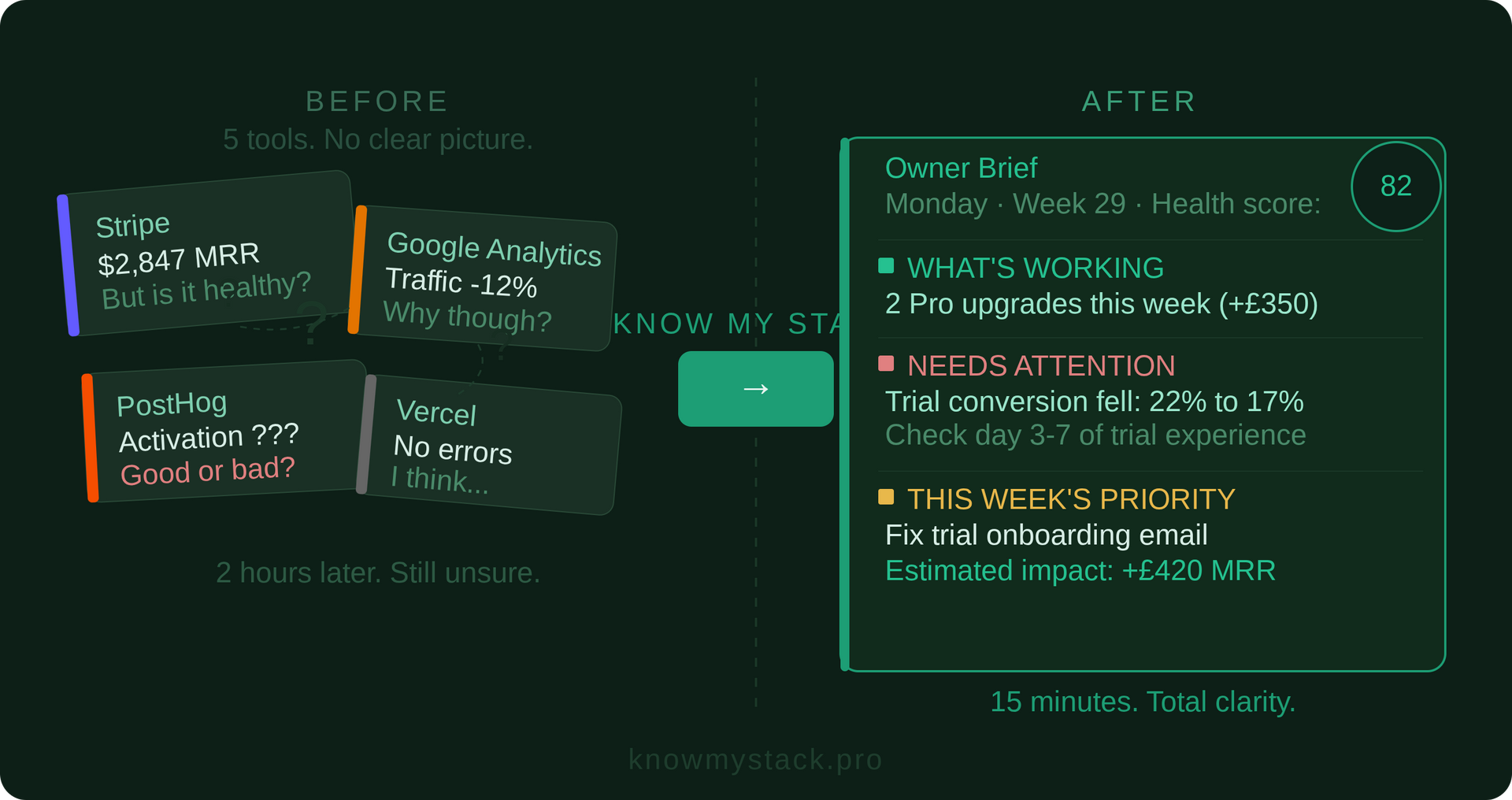
You open Stripe. You see MRR. It's up a bit. You feel good.
Then you open GA4. Traffic is down. You feel worried.
Then you open PostHog. Activation rate looks weird but you're not totally sure what it means or whether last month's number was better or worse.
You've now spent 45 minutes across three tools and you know less than when you started — because each tool gives you one piece of a puzzle, and none of them tell you what the picture is supposed to look like.
So you close the tabs, tell yourself you'll look properly at the weekend, and go back to building.
Sound familiar?
The Three Lies We Tell Ourselves
"I'll check it properly this weekend."
You won't. The weekend comes and there's something more urgent, more tangible, more solvable in front of you. The data check gets pushed again. By the time you do sit down with it, three weeks have passed and you've lost any sense of what was normal.
"If something was really wrong I'd know."
You probably wouldn't. The most damaging things in a SaaS business tend to be slow — a gradually rising churn rate, a quietly declining activation rate, a subtle drop in trial conversion. None of these announce themselves. They compound quietly over weeks until they're suddenly a serious problem.
"My numbers are fine because revenue is growing."
Revenue can grow while your business is getting less healthy. If you're acquiring customers faster than you're losing them, MRR climbs — even if churn is increasing, activation is falling, and the whole thing is more fragile than it looks. Revenue is a lagging indicator. By the time it drops, you're already months behind the problem.
What Actually Matters Every Week
You don't need to track 47 metrics. As a solo or small-team non-technical founder, you need to know five things every week:
1. Is revenue moving in the right direction, and why? Not just "is MRR up" but is it up because you got new customers, or did you just have a good month and churn is also quietly rising? The trend matters more than the number.
2. Are people who sign up actually activating? A leak at activation kills SaaS businesses slowly and invisibly. If 40% of your trial signups never do the thing that makes them realise your product's value, no amount of marketing spend will fix your growth problem.
3. Is traffic turning into signups at a consistent rate? If your conversion rate is falling while traffic stays flat, you have a messaging or landing page problem. If traffic is falling but conversion stays the same, you have an acquisition problem. These need completely different responses, but most founders just see "signups are down" and panic.
4. Are there any technical problems silently costing you money? Failed payments that haven't retried. Broken webhooks. API errors no one noticed. These are the things that quietly drain revenue while you're focused on the product.
5. What's the one most important thing to fix this week? Not a list of twelve things. One thing. The thing that, if you improved it by 20%, would have the biggest impact on the business.
That's it. If you know those five things clearly every Monday morning, you're ahead of most SaaS founders.
Why Clarity Is Hard to Come By
The reason most non-technical founders don't know these five things clearly isn't laziness. It's that no single tool tells you all of them, and making sense of the combination requires either technical knowledge, a lot of time, or both.
Stripe tells you about revenue and payments but nothing about whether your product is actually working. GA4 tells you about traffic but the interface is genuinely confusing and it takes significant expertise to extract meaningful signals. PostHog can tell you about activation and product usage but only if you've set it up correctly and know what you're looking for.
And none of them talk to each other.
The data exists. The problem is synthesis — turning five tools' worth of raw numbers into a coherent picture of business health that a busy, non-technical founder can act on in fifteen minutes.
What Good Weekly Business Clarity Looks Like
Imagine instead of logging into five tools every Monday, you received something like this:
"Revenue is up 4% this week, driven mostly by two new Pro upgrades. However, your trial-to-paid conversion has fallen from 22% to 17% over the last three weeks — this is the main thing to watch. Your traffic from Search is steady but your paid campaign is underperforming; you're paying for clicks that aren't converting. One failed payment from last week hasn't retried successfully — worth checking manually. This week's priority: look at what's happening in the trial experience between day 3 and day 7, as that's where the drop-off is happening."
No dashboards. No raw numbers you have to interpret. Just: here's your business, here's what matters, here's what to do.
That's what a good weekly business brief looks like. And it's entirely achievable — it just requires someone (or something) to do the synthesis work for you.
The Shift Worth Making
The most important mindset shift for non-technical SaaS founders isn't about learning to read data better. It's about changing your relationship with weekly business review from something you dread and avoid to something that takes fifteen minutes and leaves you feeling clear and in control.
When you know what's actually happening in your business every week — not in a vague "things seem okay" way but in a specific "here's what's working, here's what to fix, here's the one priority" way — everything else gets easier. You make better product decisions. You spend money in the right places. You catch problems before they compound.
Clarity isn't a luxury. For a solo or small-team founder, it's the closest thing to a competitive advantage you can build.
What To Do Right Now
If you're a non-technical SaaS founder and any of this resonated, here's a simple starting point for this week:
Pick the five metrics above. Pull each one manually from whichever tools you use. Write them down in plain English — not the raw numbers, but what they mean. "Trial conversion is 18%, down from 22% last month. Something is breaking in the first week of the trial." Then pick one thing to investigate based on what you wrote.
It'll take longer than it should. It'll feel harder than it should be. But doing it once will tell you a lot about which parts of your business you're currently flying blind on.
And if you'd like help making that process automatic — a weekly Owner Brief that does the synthesis for you, in plain English, every Monday — that's exactly what we're building at Know My Stack.
We're currently looking for non-technical SaaS founders to be part of our founding group. If that's you, join our community here or visit knowmysaas.comto find out more.
Know My Stack helps non-technical SaaS founders understand what's happening in their business every week — without dashboards, without data expertise, and without spending half a Sunday piecing it together. Less guessing. More clarity.

